You can walk through Saigon during the rainy season, but you need a flexible plan. Carry rain protection, wear shoes with good grip, protect your phone, and be ready to pause, shorten the route, or stop completely when rain and traffic make the street difficult. This Saigon rainy season walking guide explains what to expect without pretending that every shower follows the same pattern.
Climate summaries commonly place the wetter period around May to October or November. Those ranges describe averages, not a promise about a particular week. The start and end of the season vary between years, and a weather forecast for one day is more useful for deciding what to wear that morning than a general climate label. For background, compare the JICA report with this climate study; both provide broader context rather than a forecast for your walking day.
What rainy season means for a walking day
Saigon’s rainy season can bring short, intense showers, longer periods of rain, or changing conditions within the same day. A clear start does not guarantee a dry finish, and a dark sky does not tell you exactly how long rain will last. The sensible approach is to plan around options rather than a fixed outdoor sequence.
Rain changes the street in practical ways. Visibility can fall for drivers and pedestrians. Painted surfaces, tiles, metal covers, and uneven pavement can become slippery. Puddles may hide a broken edge or a drain, while umbrellas reduce what you can see at crossings. Traffic does not become predictable just because everyone is moving more slowly.
Do not use a climate average as if it were a live forecast. Check a reliable forecast close to departure, then look outside and reassess. If the real conditions are worse than expected, changing your plan is good judgement, not a failed itinerary.
What to pack for walking in the rain
Shoes and clothing
Choose shoes with a sole that grips on wet pavement. Very smooth soles are a poor match for polished floors, painted crossings, and puddled pavements. Quick-drying trousers or shorts are easier to manage than heavy denim, and a breathable layer is more useful than a thick jacket in warm, humid weather.
A raincoat keeps both hands available when you need to cross a road or hold a railing. An umbrella is useful for lighter rain and stationary waits, but it can block your view and compete for space on a crowded pavement. Bring whichever you can use safely; carrying both may make sense for a long day.
Phone, documents, and small essentials
Put your phone, passport copy, cash, and other sensitive items inside a waterproof pouch or a sealed inner bag rather than trusting a backpack alone. A phone that is protected from rain is also easier to use for maps and messages when you need to change plans. Carry a small towel or cloth, hand sanitiser, and a spare bag for wet clothing.
When to continue, shorten, or stop
Continue with care
Continuing can be reasonable when rain is light, visibility is acceptable, the pavement is manageable, and everyone in the group has dry enough clothing and secure belongings. Slow down at kerbs and crossings. Keep your eyes on the road rather than on your phone, and leave extra space between yourself and moving motorbikes.
Shorten the route
Shorten the walk when rain is steady, shoes are losing grip, water is collecting across your intended path, or the group is becoming cold, tired, or uncomfortable. Choose one or two meaningful stops instead of trying to complete every landmark. A shorter walk with attention is better than a long walk spent protecting bags and avoiding puddles.
Stop and wait
Stop when thunder, poor visibility, strong wind, unsafe crossings, or rapidly worsening conditions make the street a bad place to remain. Move under a genuinely sheltered, public space without blocking a shop entrance or residential doorway. Do not stand beneath trees, temporary structures, or electrical equipment simply because they look dry.
How to adjust a District 1 walking route
A typical self-guided District 1 route can include the riverfront, Nguyen Hue Walking Street, City Hall, the Opera House, Notre-Dame Cathedral, the Central Post Office, and Independence Palace. In rain, do not treat that sequence as an obligation. Our self-guided District 1 walking route can be used as a planning framework, then reduced to the sections that suit the conditions.
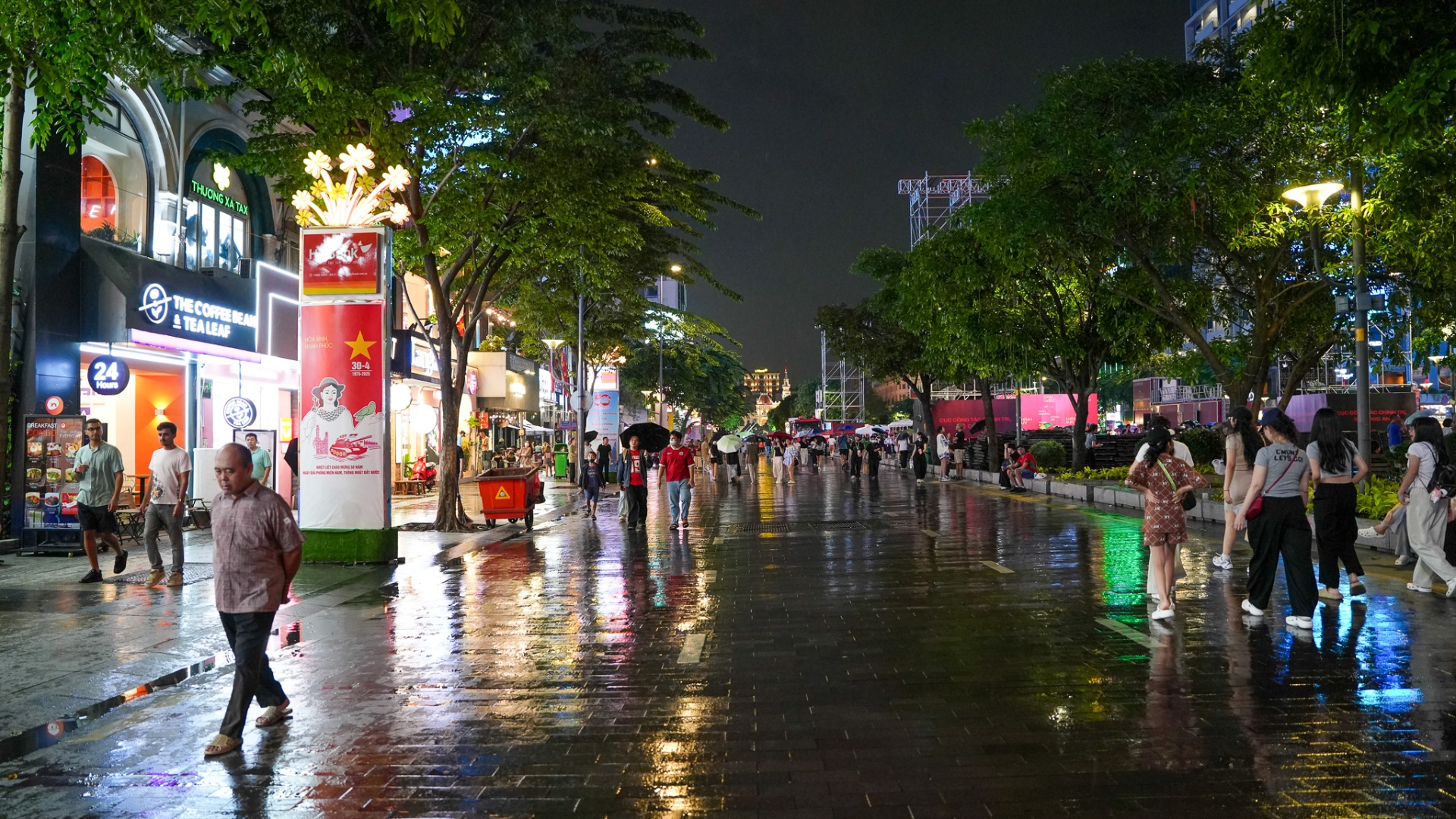
Nguyen Hue is open and exposed, so it may be better as a short crossing or a quick look rather than the centre of a long rainy walk. The riverfront can also feel more exposed to wind and spray. If visibility is poor, postpone those sections instead of forcing photographs or lingering near the road.
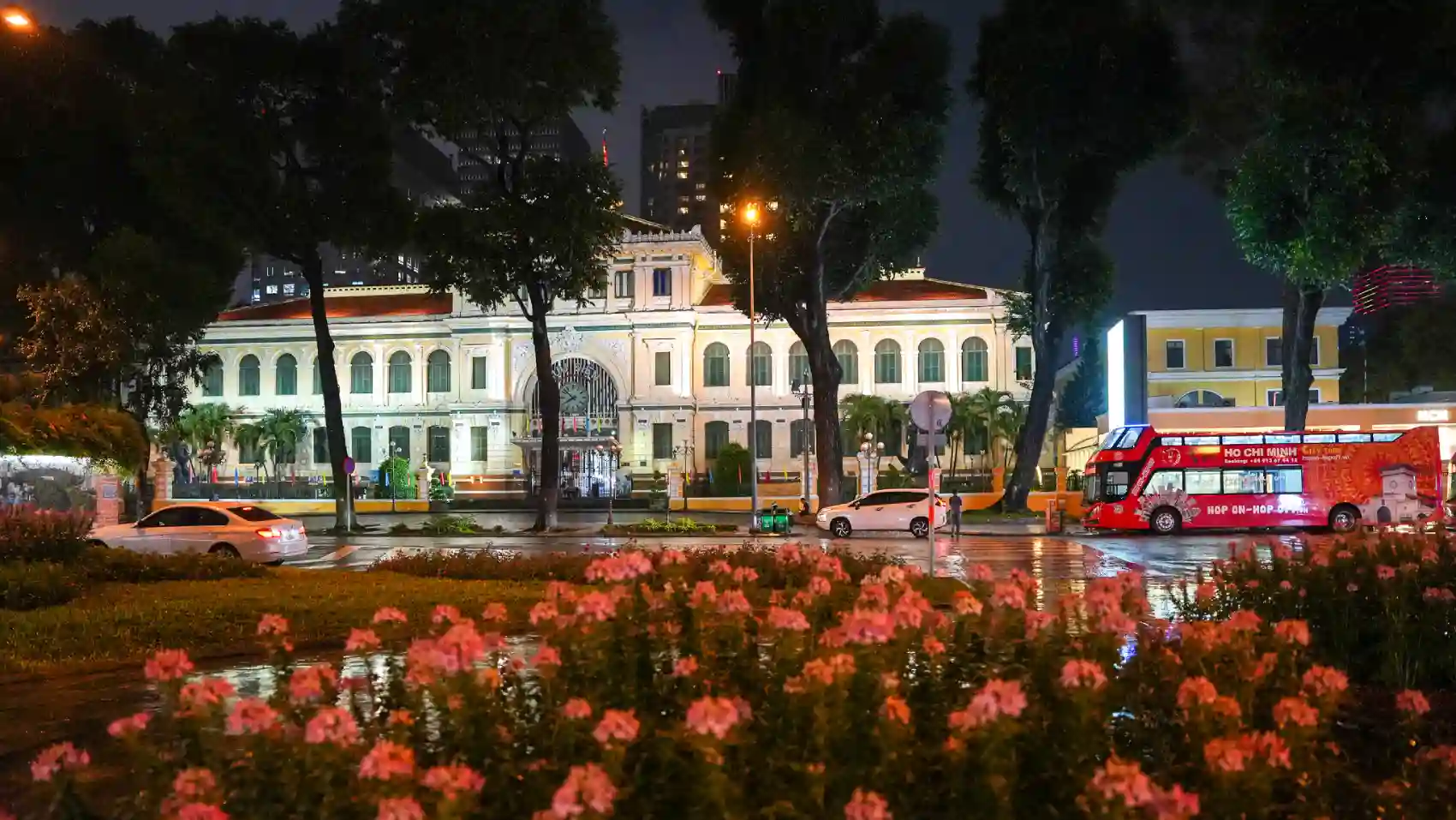
The Central Post Office is a verified indoor landmark on the District 1 route, but access and operating arrangements can change. Confirm current visitor access before relying on it as your shelter. The Central Post Office guide provides architectural context; it is not a substitute for checking current conditions.
Indoor and covered alternatives
Indoor stops should be chosen because they are suitable for the day, not because every building near a route is automatically open to visitors. The Central Post Office offers an indoor architectural stop when current access allows. The War Remnants Museum has indoor galleries, but check its official visitor information for current hours, admission, and any changes before making it your rainy-day anchor.
The War Remnants Museum guide can help you decide whether its subject matter suits your day. It is not a light weather shelter in the emotional sense; allow enough attention for the exhibitions rather than treating the museum as a place to wait out a shower.
Cafés and hotel lobbies may offer cover, but access, seating, and expectations differ. Choose a public business where you are welcome, follow its rules, and do not assume that a covered frontage is available for groups. If you need a longer break, plan a proper indoor stop before leaving your accommodation.
Crossing streets when the road is wet
Wet roads affect braking, visibility, and the way people judge gaps. Drivers may have rain on their windscreen, while your umbrella or hood limits your own view. Read our guide to crossing the street in Saigon before you go, then apply the same principle more slowly in rain: find a visible crossing point, watch several directions, and never assume that a vehicle has seen you.
Keep umbrellas low enough to see approaching traffic. Do not step from behind a parked vehicle, and do not stop in the middle of a crossing to check a map. If you cannot see clearly, wait on the pavement and reassess. A taxi or ride service can be the sensible option between two parts of a route.
If you have booked a walking tour
Contact the organiser before travelling to the meeting point if rain is heavy or conditions are changing. Ask whether the tour is going ahead, where the group will meet, whether the route has been adjusted, and what the organiser recommends you bring. Do not infer a cancellation, refund, or alternative route unless the operator confirms it directly.
The Saigon City Highlights tour and the Saigon Street Food experience are organised experiences, not self-guided rainy-season routes. Their meeting arrangements and route decisions belong to the organiser. For general context on a local-led walk, see what to expect from a local-led Ho Chi Minh City walk, then contact the operator for the specific day.
Rainy-season decisions in practice
Start with the forecast, then check the sky and street conditions before leaving. Pack for the possibility that the rain lasts longer than expected. Choose a route with a clear stopping point, save the indoor alternatives in your phone, and tell your companions what would make you turn back.
If conditions worsen, end the walk and continue another day.
Frequently asked questions
- Can you walk around Saigon during the rainy season?
- Yes, if you plan for changing conditions and are willing to shorten or pause the route. Rainy-season walking is not automatically unsafe, but heavy rain, poor visibility, slippery surfaces, and traffic can make a planned walk unsuitable at times.
- When is Saigon’s rainy season?
- Climate summaries commonly place Saigon’s wetter season around May to October or November. The transition varies from year to year, so a seasonal average is not a forecast for a particular day.
- Does rain in Saigon always stop quickly?
- No. Some showers are brief, while others are heavier or last longer. Do not start a long outdoor route on the assumption that every shower will pass quickly.
- What should you wear for a rainy-season walk?
- Wear shoes with good grip, quick-drying clothing, and a light rain layer. Carry a compact umbrella or raincoat, protect your phone and documents in waterproof bags, and keep a dry change of clothes available if you are walking for much of the day.
- Should you still join an organised walking tour if rain is forecast?
- Contact the tour operator directly and ask about the meeting point, current conditions, route changes, and whether the walk is going ahead. Do not assume that another tour operator’s policy applies to your booking.