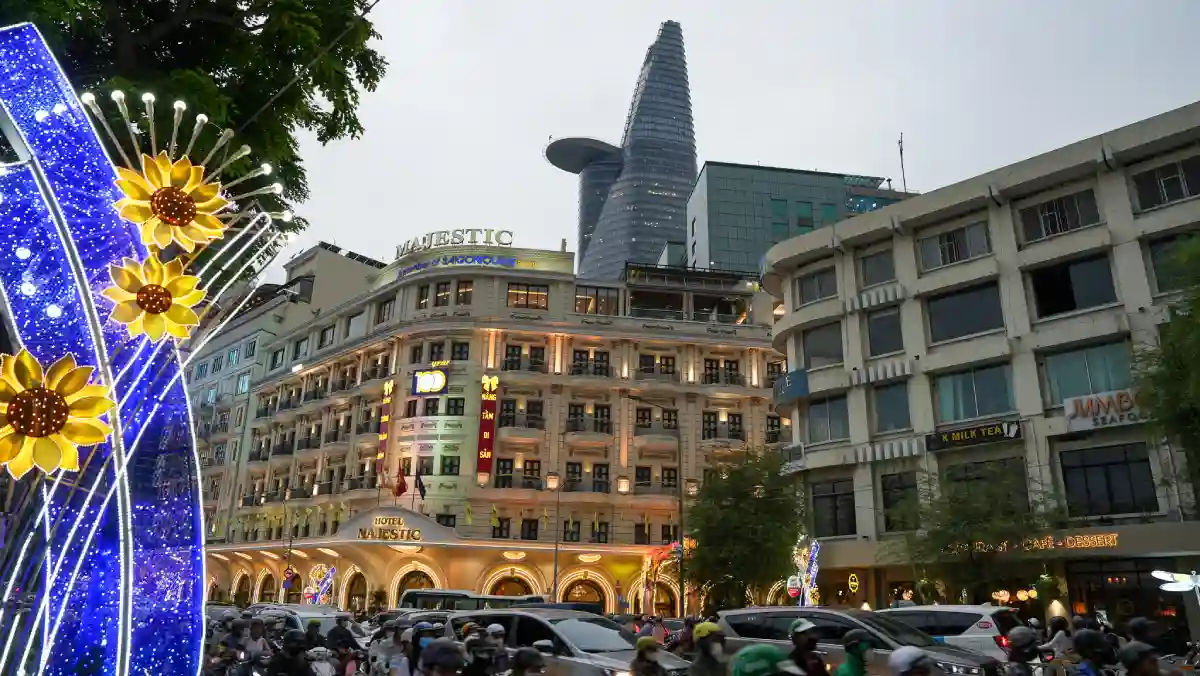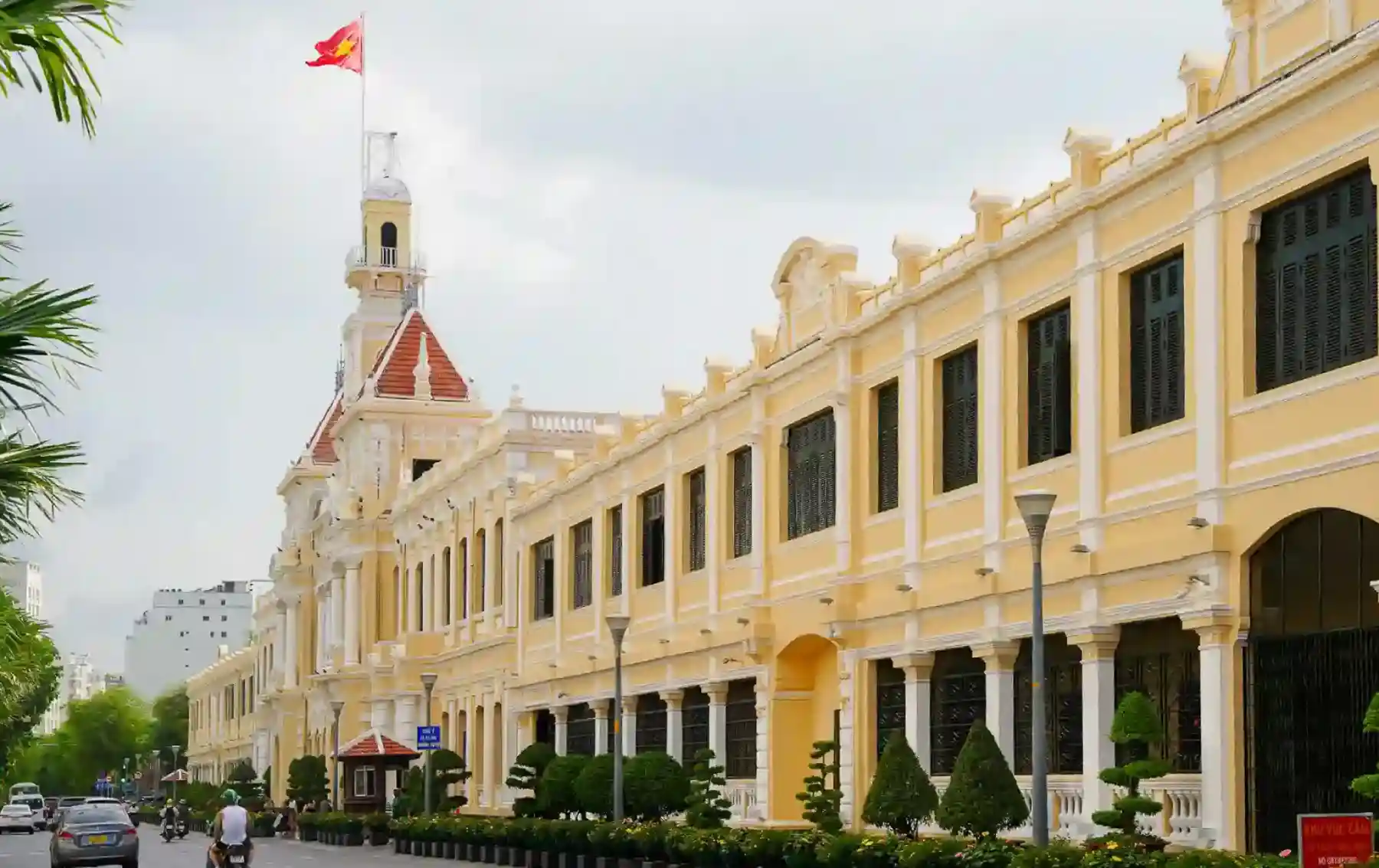
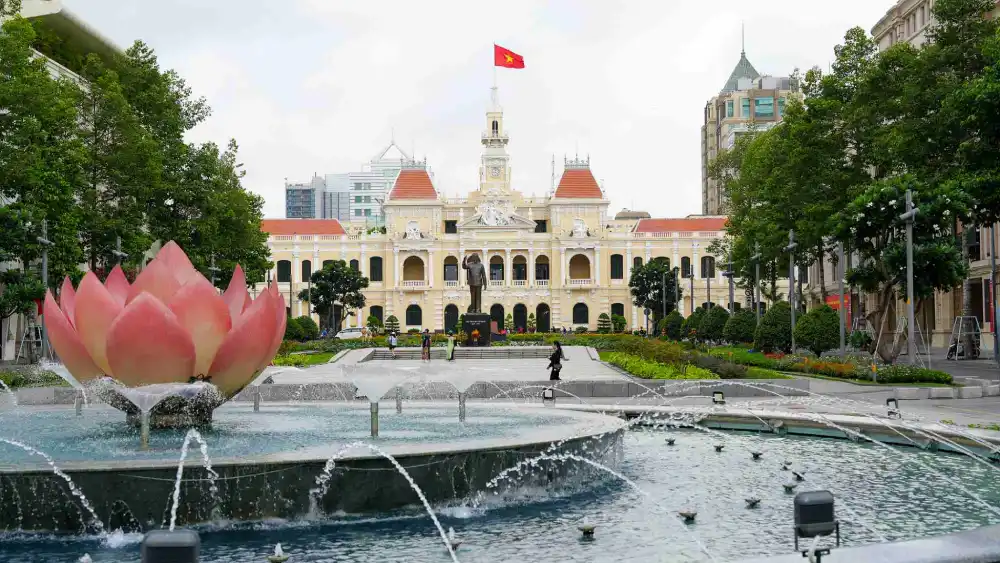
You can walk central District 1 on your own by following one clear line: start at Bach Dang Wharf, move up Nguyen Hue Walking Street, then pass City Hall, the Opera House, Notre-Dame Cathedral, the Central Post Office, and finish at Independence Palace . No tour booking is required. You choose when to start, how long to linger, and whether to add Ben Thanh Market or the War Remnants Museum at the end.
This is a logistics guide for independent walkers. Each landmark has a separate story on our site if you want depth on architecture or history. Here the focus stays on order, pacing, and practical decisions on the street.
Before you start
You do not need a booking or a meeting time. Pick a morning or late afternoon if you want softer light and slightly cooler air; midday works too if you plan shade stops. Wear shoes you would trust on uneven pavement and carry water — convenience stores are easy to find along Nguyen Hue and near the cathedral block. The riverfront has fewer obvious quick stops than Nguyen Hue.
Save the landmark articles to your phone before you leave Wi‑Fi. Each stop on this list has a dedicated page on our site with deeper context; this route article stays focused on order and street-level decisions. A paper map is optional. Most walkers use a familiar maps app for orientation between blocks, but you do not need turn-by-turn navigation for the core sequence once you reach Nguyen Hue.
Is District 1 walkable for first-time visitors?
For the landmark core, yes. District 1 packs the riverfront, a pedestrian boulevard, French-colonial buildings, and major museums into a relatively small area. Footpaths exist, but they are shared with motorbikes, café furniture, and delivery stacks. You will not have a European-style pedestrian zone for the whole walk.
What makes self-guiding workable is continuity: once you reach Nguyen Hue, you can walk several stops without needing a taxi. The harder parts are the first crossing from the wharf and the busier intersections near the cathedral and palace. Read our notes on crossing the street in Saigon before you set out, especially if traffic still feels chaotic.
The self-guided District 1 walking route, stop by stop
Walk in this order. The sequence follows geography so you are not doubling back across District 1 unless you choose an optional ending.
1. Bach Dang Wharf and the Saigon River
Begin on the river side. Bach Dang gives you orientation: the water, the skyline, and the distance between old Saigon and the towers behind it. It is a sensible place to take a first photograph and adjust to the heat before you turn inland. Our Bach Dang guide covers what to notice along the promenade without repeating that detail here.
2. Nguyen Hue Walking Street
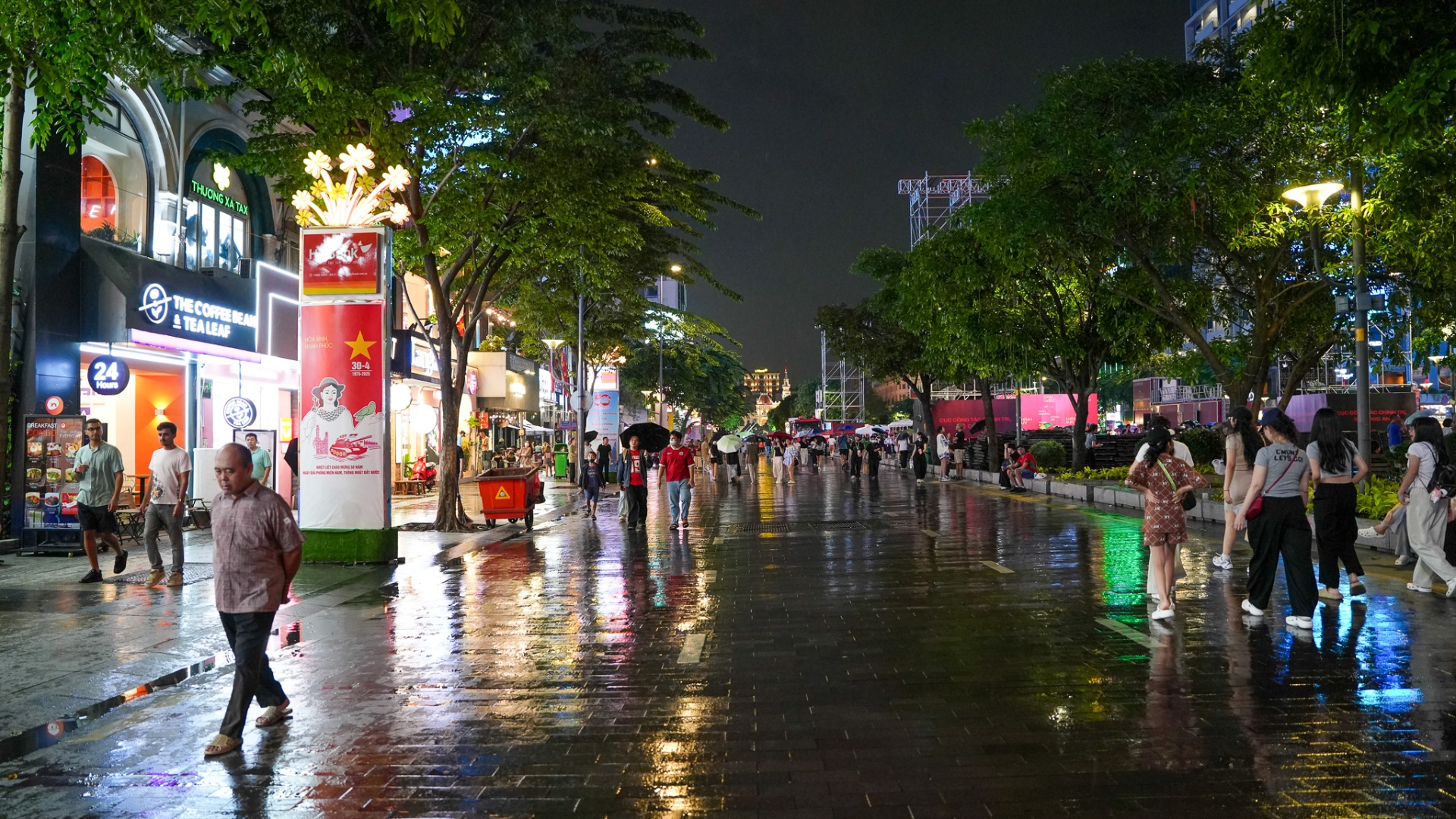
From the river, head to Nguyen Hue. The central lanes form a wide pedestrian space between City Hall and Ton Duc Thang Boulevard. On weekend evenings the whole boulevard often closes to vehicles, which makes this the easiest stretch of the walk. Even on a weekday, the middle section feels open compared with surrounding traffic.
Treat Nguyen Hue as your first proper rest zone. Cafés line the sides; shade appears under the trees; you can sit without committing to a long indoor stop. The Nguyen Hue article goes further on atmosphere, evenings, and photo spots.
3. Ho Chi Minh City Hall (exterior)
City Hall sits at the northern end of Nguyen Hue. You view the building from the square; the interior is not a casual tourist walk-in. A short stop here is enough for photos and to see how the statue and plaza frame the façade. For the building’s history and architectural details, use the City Hall story.
4. Saigon Opera House (exterior)
From City Hall, walk south-east towards Lam Son Square. The Opera House is an exterior stop unless you hold a ticket for a performance. The square itself is busy with traffic, so pick your crossing point carefully. The Opera House guide explains the façade and programme; this route only marks it as the next landmark on the line.
The block around Dong Khoi and Le Loi carries more boutique traffic and café tables than Nguyen Hue. If you want a sit-down break, this is a reasonable place to pause before you move towards the cathedral — still on foot, still in District 1, but a change of street rhythm from the open boulevard.
5. Notre-Dame Cathedral (exterior)
The cathedral faces Paris Commune Square, a short walk from the post office block. A long-running restoration project means scaffolding and access limits can change without much notice. Plan to appreciate the red brick and the square from outside unless you have confirmed current entry rules. Do not assume the interior is open for sightseeing. See Notre-Dame Cathedral Saigon for restoration background.
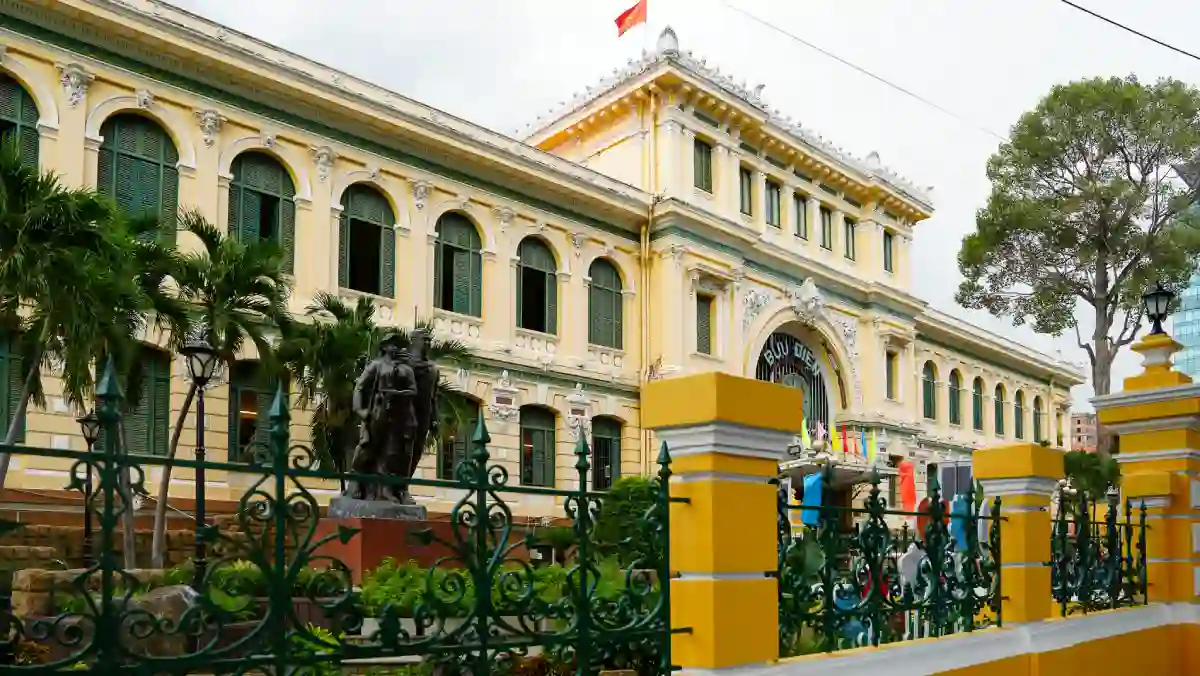
6. Saigon Central Post Office
The post office stands opposite the cathedral. It is one of the few indoor stops on the route that does not require pre-booking: you can step inside, look up at the vault, watch locals at the counters, and cool down. Opening times can vary by day; confirm on arrival or through Vietnam Post channels if you are unsure. Architecture and visitor tips live in the Central Post Office article.
7. Independence Palace
Continue south on Nam Ky Khoi Nghia to Independence Palace. From the street you can take in the gates and lawns; going inside is optional and ticketed. If you enter, allow a separate block of time for the exhibition rooms. Official visiting hours and prices are listed on dinhdoclap.gov.vn — check there on the day you walk rather than relying on secondary lists. The Independence Palace guide covers what you see inside when access is available.
Optional endings after Independence Palace
The core self-guided District 1 walking route ends at the palace. Two common extensions:
Ben Thanh Market. Continue toward Ben Thanh Market if you want a market atmosphere, street food nearby, and a familiar meeting point many travellers already know. Read Ben Thanh Market before you go inside the stalls.
War Remnants Museum. Head north-west for a focused indoor visit on modern Vietnamese history. It is emotionally heavy and deserves unhurried time. Tickets and hours are published on baotangchungtichchientranh.vn. Our museum guide outlines what to expect in the galleries.
You do not need both endings on the same day. Choose one if you still have energy, or finish at the palace and return another time.
Pacing, rest stops, and how long to allow
There is no single correct duration for a self-guided District 1 walking route in Ho Chi Minh City. A brisk walker who stays outside every building will finish faster than someone who enters the post office, tours Independence Palace, and stops twice for coffee on Nguyen Hue.
Build your day around pauses rather than a fixed schedule. Nguyen Hue and the post office are the obvious rest points: seating, shade, and air conditioning. Carry water; District 1 heat catches people out even on cloudy days. If rain arrives, shorten the outdoor sections, wait under cover, and pick up the route when it passes. Showers can pass quickly, but not always.
Treat indoor tickets as separate decisions. Independence Palace and the War Remnants Museum each deserve unhurried time if you go inside; trying to squeeze both on the same half-day walk often feels rushed. Ben Thanh Market is lighter to browse in short bursts — useful if you mainly want food and atmosphere without a museum pace.
Weekend evenings change the feel of Nguyen Hue when the full length closes to traffic. Weekday walks are quieter on the boulevard but busier on surrounding roads. Neither is wrong; match your start to what you prefer — people-watching and street energy, or an easier crossing environment earlier in the day.
Self-guided walk vs the Saigon City Highlights tour
The two options share geography but not experience. Walking alone gives freedom: a late start, a long lunch, or skipping a stop without affecting anyone else. You read what you want, when you want, and you pay only for tickets you choose to buy.
The Saigon City Highlights tour adds a local guide, a small group, and a narrative that links landmarks to everyday Saigon — why a building matters, how the city changed, what locals notice that maps omit. The tour follows a planned arc with room for questions. It suits first-time visitors who want context on the first walk rather than a solo orientation.
Neither approach is inherently better. Many travellers walk District 1 once on their own, then join a guided walk later in the trip when they know which questions to ask. Others do the tour first and retrace favourite stops independently the next day.
Frequently asked questions
- Can you walk District 1 without a guide?
- Yes. The main landmarks in central District 1 sit close together, and this route follows public streets and squares you can reach on foot. A self-guided walk suits travellers who prefer their own pace, longer photo stops, or a flexible start time. It does not replace the context a local guide adds on a structured tour.
- How long does this self-guided walk take?
- There is no fixed duration. Your total time depends on walking speed, how long you pause at each stop, whether you go inside Independence Palace or a museum, and how busy the streets are. Build in extra time for crossings, shade breaks, and queues if you buy tickets on arrival.
- Can you go inside Notre-Dame Cathedral on this route?
- Notre-Dame Cathedral Saigon has been under a major restoration project since 2017. Access rules can change as work progresses. Before you plan an interior visit, check the latest guidance from the cathedral or your hotel. See our dedicated Notre-Dame Cathedral Saigon article for restoration background.
- Where should the walk end?
- The core route finishes at Independence Palace. From there, many walkers continue toward Ben Thanh Market for food and shopping, or north-west to the War Remnants Museum if you want an indoor stop focused on modern history. Both are optional add-ons, not part of the main landmark chain.
- Is this the same as the Saigon City Highlights tour?
- No. The Saigon City Highlights tour is a guided, tip-based walk with a set meeting point, a small group, and a local guide who connects the landmarks with stories and everyday context. This article is for travellers walking independently without a booking.
- Do you need tickets for Independence Palace or the War Remnants Museum?
- Both sites charge admission for visitors who enter the exhibitions. Fees and opening hours can change. Check the official Independence Palace site (dinhdoclap.gov.vn) and the War Remnants Museum site (baotangchungtichchientranh.vn) before you go. Figures quoted elsewhere online may be out of date.